Sometime in the fifth century BCE, a philosopher from the Greek colony of Elea set out to prove that motion is impossible. Not difficult, not illusory in some poetic sense — literally, logically impossible. Zeno of Elea never denied that we appear to move. He denied that the appearance could survive contact with reason. And for roughly two thousand years, no one could fully explain why he was wrong.
That is the strange gift of a good paradox. It does not merely puzzle; it exposes a crack in something we assumed was solid. Zeno's arguments look like word games until you try to answer them precisely — and then they reach straight down into the foundations of space, time, and number.
Achilles and the Tortoise
The most famous of Zeno's paradoxes stages a race. Achilles, the swiftest of the Greeks, gives a tortoise a head start. Common sense says he wins easily. Zeno says he can never even catch up.
The argument runs like this. Before Achilles reaches the tortoise, he must first reach the point where the tortoise began. But in the time it takes him to get there, the tortoise has crawled a little further ahead. Achilles must now reach that new point — by which time the tortoise has again moved on. Each time Achilles arrives where the tortoise was, the tortoise is somewhere else. The gap shrinks, but it never closes. There are infinitely many gaps to cross, and infinity, Zeno insists, cannot be finished.
The Arrow That Never Flies
If the tortoise attacks motion across space, the Arrow attacks it across time. Consider an arrow in flight, and freeze it at a single instant. In that instant, the arrow occupies a space exactly equal to itself. It is not moving to where it is — it is already there — nor to where it is not. So at every instant, the arrow is motionless. And if it is motionless at every instant, when does it move?
What is in motion moves neither in the place it is nor in one in which it is not.
— Zeno of Elea, as reported by Aristotle in the Physics
The Arrow forces a question we rarely ask: is time made of instants the way a string is made of beads? If it is, then motion has to somehow live inside instants that individually contain none of it. The paradox is not resolved by insisting the arrow obviously moves. It is resolved only by rethinking what an instant is.
How Infinity Learned to Add Up
The escape from Achilles and the tortoise begins with a claim that would have sounded absurd to Zeno: infinitely many numbers can add to a finite total. Take the distances Achilles must cross. If the whole race is one unit long, the gaps form a series — one half, then a quarter, then an eighth, and so on forever.
1/2 + 1/4 + 1/8 + 1/16 + ...  =  1

     S = Σ (1/2)^n   for n = 1, 2, 3, ...
S = 1Each term is real, each is positive, and there are infinitely many of them — yet they converge on exactly 1. Achilles does cross infinitely many intervals, but they nest inside a finite distance and a finite time. The infinite is not the same as the unbounded. Zeno assumed that endless meant limitless; convergence shows it need not.
What Zeno Still Knows That We Don't
It would be tidy to say calculus killed the paradoxes and move on. But the mathematics answers a narrower question than the one Zeno asked. Convergent series show that the sum of the gaps is finite. They do not, by themselves, explain how a runner completes an actually infinite sequence of distinct tasks — arriving here, then here, then here — with no last task to finish.
- The mathematical dissolution: the distances sum to a finite limit, so no infinite total is required.
- The metaphysical residue: whether space and time are infinitely divisible, or ultimately granular, is still an open question in physics.
- The methodological lesson: a paradox is not a failure of thought but an instrument that measures the depth of our assumptions.
Modern physics has not closed the door Zeno opened. Quantum gravity flirts with the idea that space and time might not be infinitely divisible at all — that below the Planck scale, the smooth continuum of the geometers gives way to something discrete. If so, then Zeno's assumption that a line can always be halved again may be false for the deepest reason imaginable: because the world runs out of halves.
The paradoxes of Zeno have been, in one form or another, at the center of the analysis of the continuum ever since he stated them.
— Bertrand Russell
Zeno set out to abolish motion and failed. What he accomplished instead was subtler and more lasting: he showed that our most ordinary experience — a step, a thrown arrow, a race across a field — rests on ideas about the infinite that we had never bothered to examine. The runner reaches the finish line. But he carries, in the infinitely many steps behind him, a question that mathematics learned to answer and philosophy is still learning to ask.
References
- 1Aristotle. Physics, Book VI. Translated by R. P. Hardie and R. K. Gaye. In The Complete Works of Aristotle, edited by Jonathan Barnes. Princeton: Princeton University Press, 1984.
- 2Russell, Bertrand. Our Knowledge of the External World. London: George Allen & Unwin, 1914.
- 3Salmon, Wesley C., ed. Zeno's Paradoxes. Indianapolis: Hackett Publishing, 2001.
- 4Huggett, Nick. "Zeno's Paradoxes." The Stanford Encyclopedia of Philosophy, Winter 2019 Edition.
Share this essay
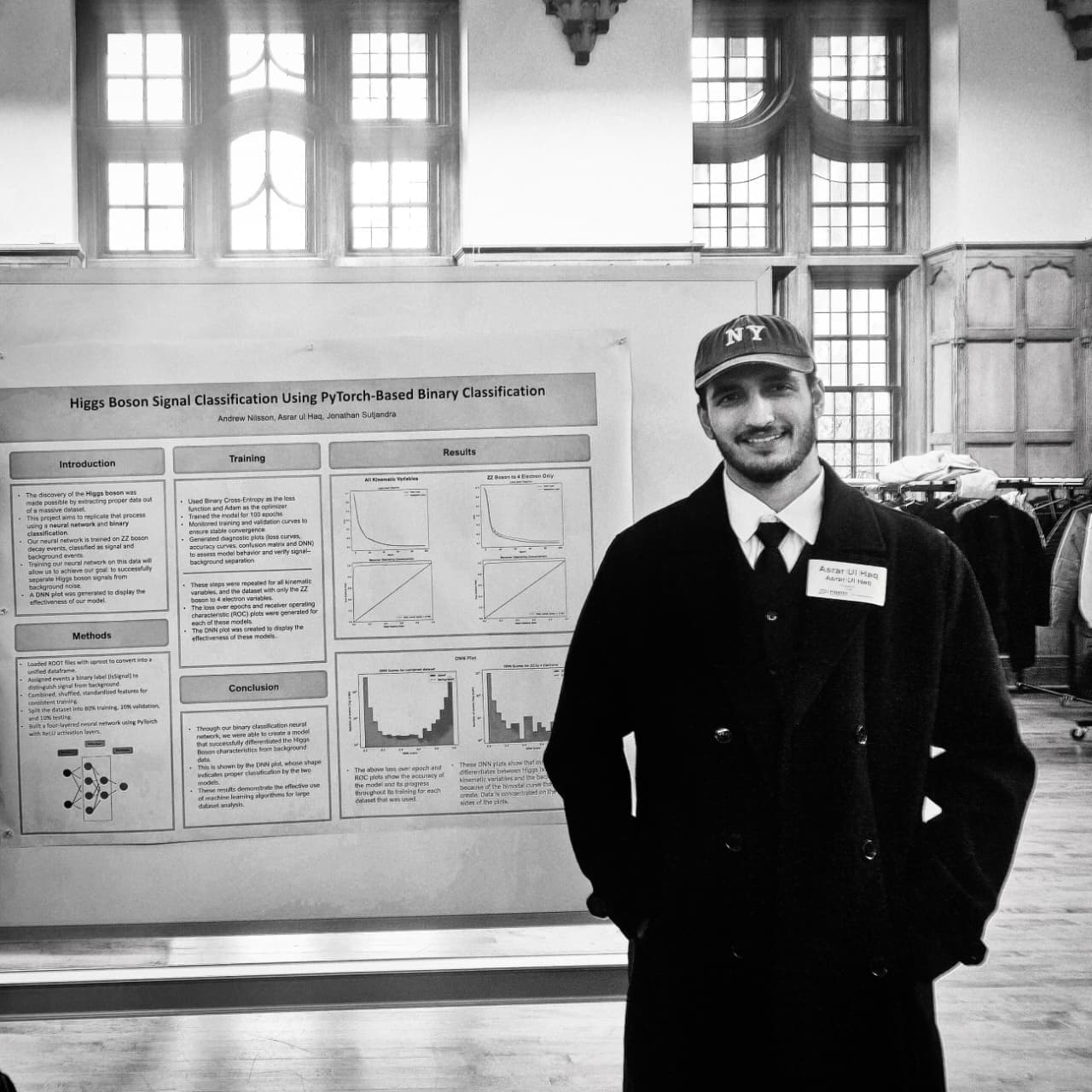
Written by
Asrar ul Haq
Mechanical Engineering and Philosophy Student at Purdue University.